How to Measure AI Search Visibility: A Practical Framework
Key answerAI search visibility is the presence of your brand or pages in the answers you observe for a defined set of questions. Measure it with a repeatable prompt log, a clear citation denominator, and separate website outcome reporting. Keep observed answers, Search Console data, and conversions distinct so the report explains what each signal can support.
AI search visibility needs an evidence trail before it needs a dashboard. For Generative Engine Optimization (GEO), my priority is a report that connects observed answers to an accountable website decision. A brand mention, a website link, and a completed enquiry are different signals. Each signal answers a different business question. My approach is to keep those signals separate with an evidence-to-action worksheet. The worked example below is hypothetical.
If you are setting up the underlying website first, review how SEO works. Technical eligibility and useful content deserve their own workstream alongside measurement.
Define AI search visibility before collecting results
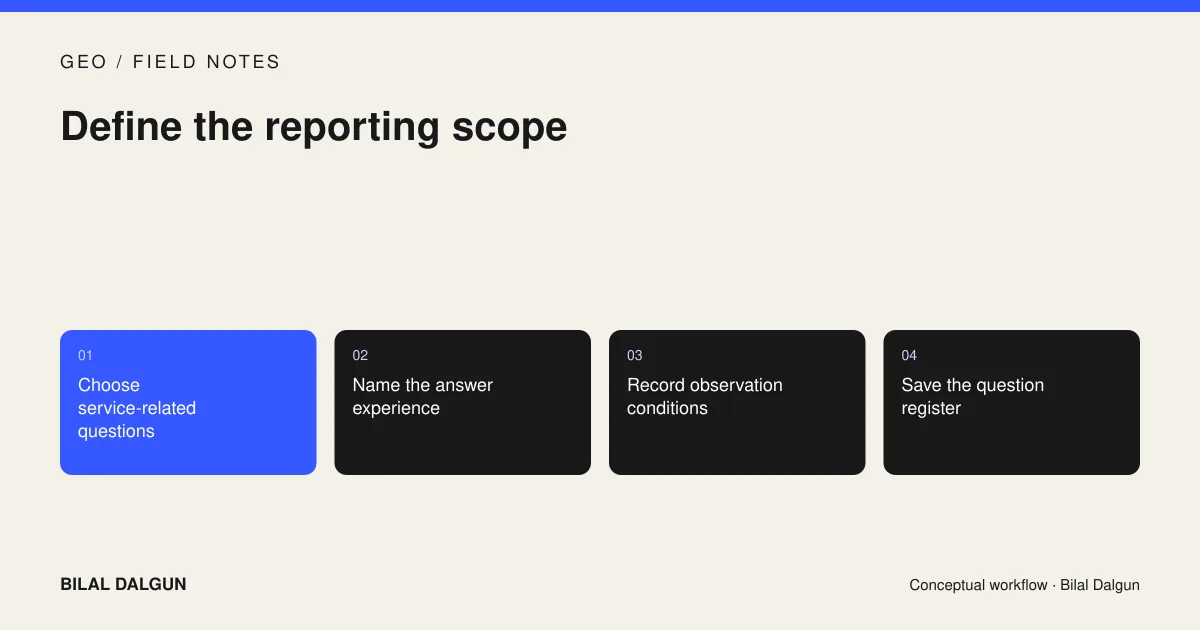
Define the scope as a named set of questions, an answer experience, and an observation period. Record what appeared in those observations. Avoid presenting a sample of answers as the percentage of all potential customers who have seen your business.
Keep a prompt register with the exact question, the reason it matters, and the page you hope will help answer it. Add the observation date and the experience used when you run the question. If location, language, or account conditions matter to your test, record those conditions too. The recommendation is to make comparisons inspectable, not to pretend that every reader receives the same answer.
Choose questions connected to a buying decision or a service problem. An example might ask how a small team should evaluate its website reporting process. Label it as a proposed test question unless you have actual query or customer evidence for it. Do not claim that a question is popular merely because it sounds plausible.
For implementation support, SEO and GEO services can help connect technical work, useful content and a reporting plan. The measurement plan should describe a decision the team can make, rather than promise inclusion in an answer.
Use an evidence-to-action worksheet
Use the worksheet below to connect an observation with an action and a limitation. I use these five fields to organize the measurement plan. They describe a reporting method, not an official Google metric.
| Field | What to record | Decision and limitation |
|---|---|---|
| Prompt set | Saved questions and their business purpose | Keep the scope explicit; the list is a sample, not total market demand |
| Run conditions | Date, answer experience and relevant test conditions | Compare like with like and flag changed conditions |
| Mention observation | Whether the named brand appeared in the saved answer | Review the surrounding wording; a mention does not prove an endorsement |
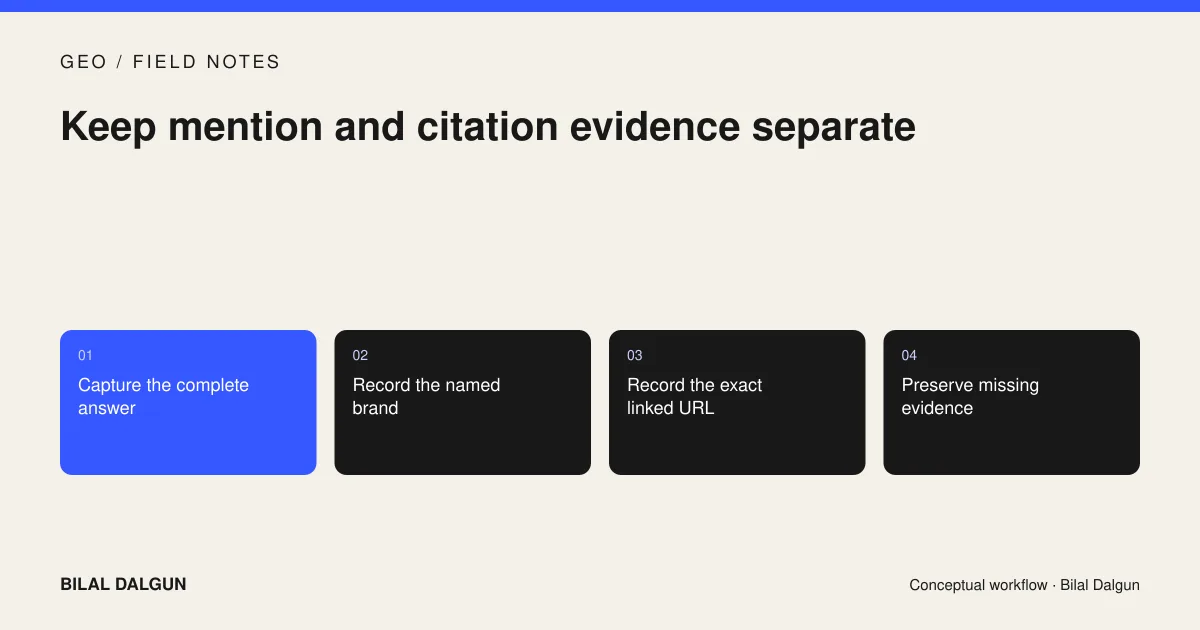
| Citation observation | The exact linked URL, or no website citation | Inspect which page was linked; a brand mention alone does not establish a citation |
| Downstream signal | Separately identified visits or enquiries, with attribution limits | Assess website outcomes without claiming every outcome came from the observed answer |
Save the answer text or a suitable evidence capture with each observation. A colleague should be able to inspect why an item was marked as a mention or a citation. Treat broken captures and incomplete answers as missing evidence, and show how they were handled instead of silently counting them as success.
Write the denominator beside every rate. For example, a rate based on completed observations should not quietly switch to all saved prompts in the next report. Preserve the underlying counts so a reader can distinguish a changed answer pattern from a changed sample. If the prompt set changes, annotate the change before interpreting the trend.
Separate Google reporting from your prompt observations
Read each reporting claim with its date and scope. Google's AI features documentation, updated December 10, 2025, describes AI feature traffic within Search Console's overall Web performance reporting. Its generative AI optimization guide, updated July 10, 2026, points readers to a Generative AI performance report. These dated descriptions should not be collapsed into a promise that every report exposes the same information.
Use the documentation relevant to the reporting surface available to your property, and label the export you actually use. A Search Console export and a manually observed answer are different records. Do not use one as evidence of the contents of the other unless you have a documented connection between them.
Google's December 2025 documentation also discusses Analytics as a way to examine website outcomes. In this proposed worksheet, keep that outcome evidence in its own field. Describe attribution gaps plainly. A visitor or an enquiry can be useful evidence without proving that a particular saved answer caused it.
The July 2026 guide continues to connect AI search work with useful content and established SEO practices. Measurement should therefore help prioritize concrete website improvements. It should not become a reason to promise a special markup trick or guaranteed search exposure.
Turn the worksheet into a decision
Choose an action only after identifying which layer of evidence is missing. The following is a hypothetical example, not a client result or a benchmark: a team saves ten completed answer observations, finds its brand in three, and finds a link to its own website in one. For this example, the observed mention rate is three divided by ten, while the observed website citation rate is one divided by ten.
Those counts do not establish market share, buyer reach, revenue impact, or a stable probability for future answers. They describe the saved sample. The difference between the mention and citation observations gives the team a specific question to investigate: what did the answers say, and which pages did they actually link?
If the brand appears but the intended page is absent, inspect the saved answers and the page's relevance before commissioning more content. If a page is cited but there is no reliable visit evidence, document that limitation rather than reporting a conversion win. If the observations themselves are incomplete, fix the collection process before changing the website on their basis.
For a team that needs a repeatable handover, my recommended approach is to document the capture method, the denominator, and the action owner together. I want another person to be able to inspect the evidence before acting on it. The practical books and guides offer another place to explore the wider SEO and GEO workflow.
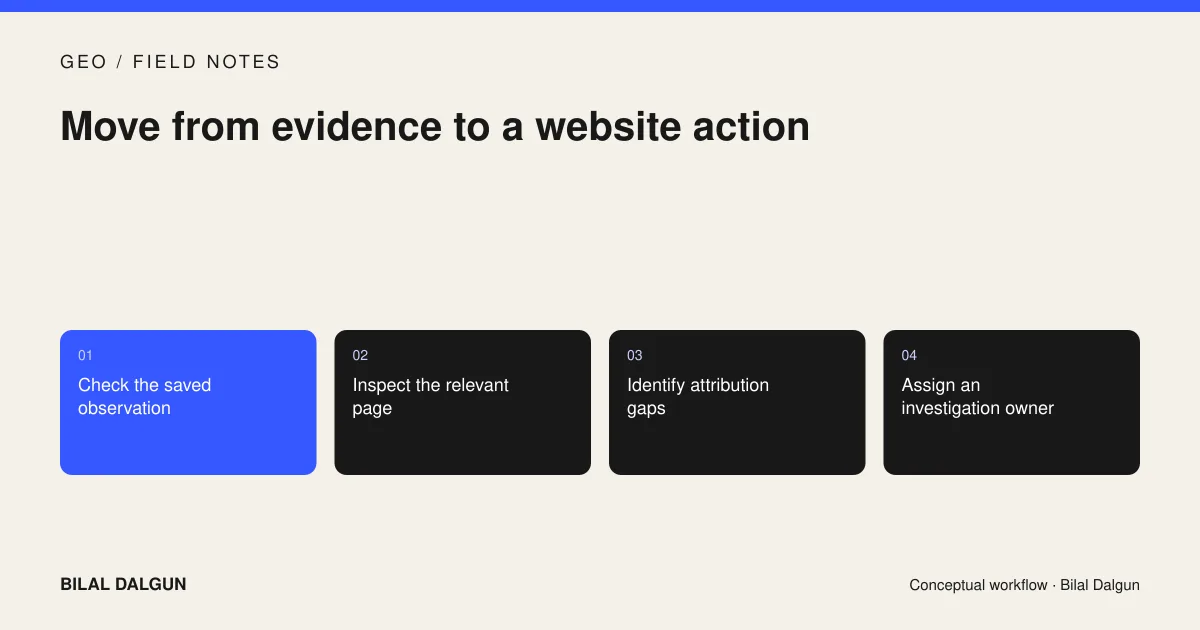
How I approach AI search visibility reporting
I start with the capture method and the denominator. I want to know exactly what a rate describes before discussing a change in performance. Keep a change log beside the report. Record edits to the prompt set, the collection method, and the website pages being assessed. Use that context when deciding whether two observation periods are comparable. A chart without these notes may look precise while hiding a change in what was measured.
Review the saved answer as well as the count. A mention that misstates a service needs a different response from a useful link to the intended page. Keep qualitative notes short and tied to the actual capture. Avoid turning an opinion about answer quality into an unexplained numerical score.
Key takeaways
- Define the prompt sample and observation conditions before comparing results.
- Keep brand mentions and exact website citations as separate observations.
- Show the denominator and preserve the evidence behind each rate.
- Identify Google reporting exports by their scope and documentation date.
- Keep website outcomes separate and state attribution limits.
- Use the worksheet to choose a concrete investigation or website action.
FAQ
Should I use a tool or manual spot-checks?
I would start with an inspectable log, then choose a tool if it makes that same process easier to maintain. Save the questions, answer evidence and observation conditions either way. A dashboard should help you review the underlying records and make a website decision; its appearance alone is not evidence that the measurement is useful.
Should AI visibility be a separate KPI from SEO?
I would keep a separate observation field for AI answers while reviewing it alongside the wider website goals. A prompt log and a Search Console export have different scopes. Combining their scores without explaining those scopes hides what each record can support. Keep the evidence distinct, then discuss the website decision the records help you investigate.
How should I track a brand mention without a direct link?
Record the brand mention and leave the website citation field empty when the saved answer contains no link to your website. That preserves a useful observation without turning it into a traffic claim. Add a short note about how the brand was described, and retain the answer evidence so another person can check the entry.
What to do next
- Create a prompt register and explain the business purpose of each question.
- Add the worksheet fields and save the evidence behind completed observations.
- Review the reporting scope with the person responsible for website analytics.
If your team needs a measurement plan tied to its website and service goals, book a reporting discussion.
Sources

Related posts
- 01
The $50 Robot Hand That’s Embarrassing $50,000 Industrial Arms
OpenClaw and generative AI are doing to robotic grippers what Linux did to enterprise software. And the industry hasn't fully caught up yet.
Read article - 02
OpenClaw + Claude + Generative AI: The Open-Source Stack Quietly Building Tomorrow’s Robots
The open-source stack quietly building tomorrow's robots isn't quiet because it's small. It's quiet because the people building with it are too busy building.
Read article - 03
Designing Robot Claws With AI: The Future of Hardware Is Being Prompted Into Existence
How generative AI is collapsing the gap between an idea and a working robot gripper, and what it means for everyone who builds physical things.
Read article