
Google AI Overviews Eligibility Audit: Technical and Content Checklist
Key answerGoogle AI Overviews eligibility depends on standard Search indexing and snippet availability rather than special AI tags or secret feeds. To qualify, a page must be crawlable, indexable under Google Search Essentials, and free of blocking snippet directives. Eligibility makes a page retrievable by grounding systems, while source selection decides whether Google cites it.
Teams often confuse whether a page is eligible for Google AI Overviews with whether Google chooses to cite it. When organic traffic shifts or competitors appear in AI summaries, marketers look for hidden markup or proprietary submission forms that do not exist. A proper google ai overviews eligibility audit separates binary technical gates from competitive citation quality. That distinction saves weeks of wasted engineering time and focuses your edits on the pages most likely to earn visibility.
What is google ai overviews eligibility?
Google AI Overviews eligibility means a page satisfies Google's baseline technical requirements to be crawled, indexed, and summarized in generative Search features. According to Google Search Central's AI features guide, there are no extra technical requirements or special files needed to appear in AI Overviews or AI Mode.
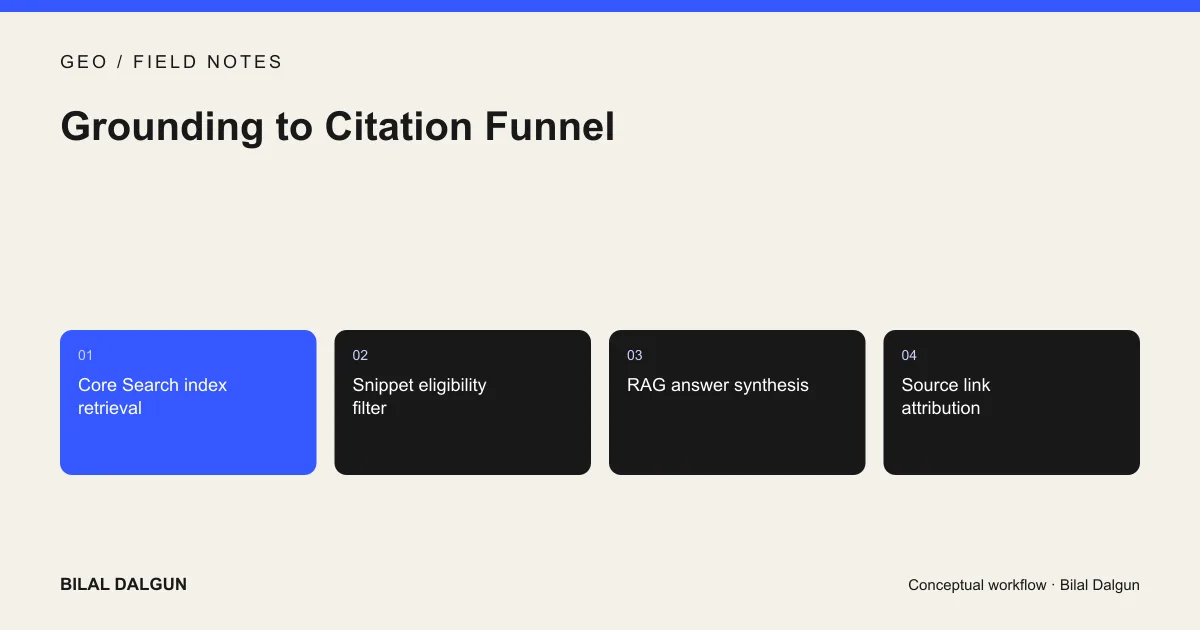
Google grounds these generative answers in its core web index using retrieval-augmented generation (RAG), as explained in Google's generative AI optimization guide. If a page cannot be indexed or if page-level directives forbid text previews, Google's grounding layer cannot surface or cite its content.
Eligibility is therefore a prerequisite, not a guarantee. Passing every technical gate puts your URL into the candidate pool, after which Google's ranking and quality systems determine which links appear alongside the summary.
The Two-Gate AI Overviews Eligibility Worksheet
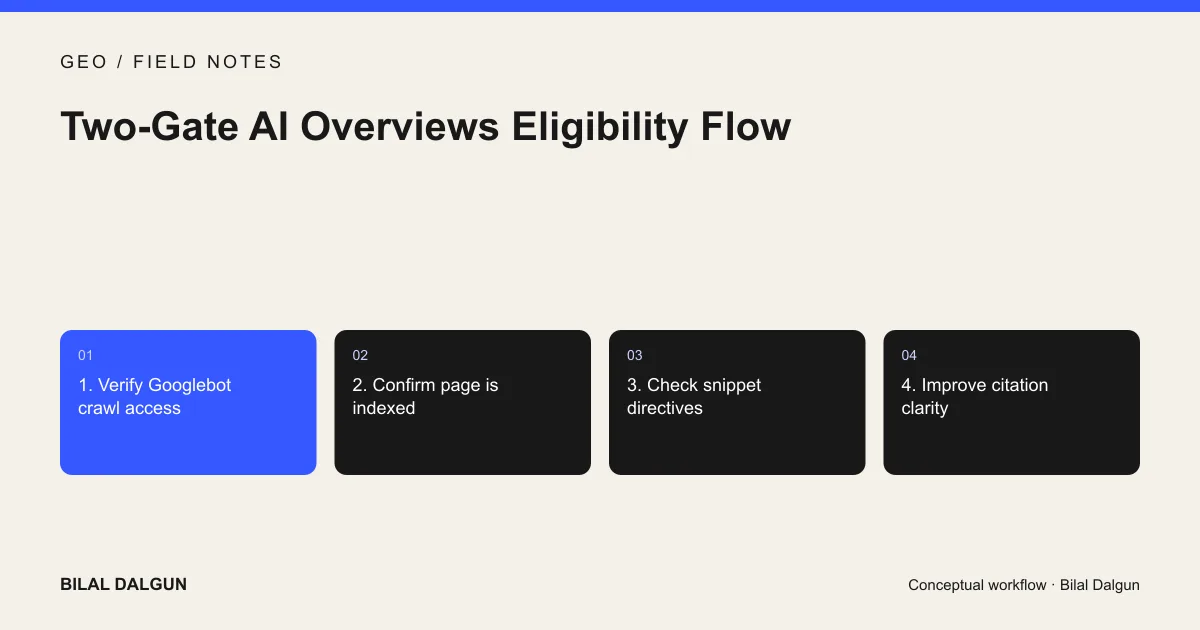
I separate every audit into two layers: Gate A covers hard technical eligibility, while Gate B evaluates whether a page is clear enough to win citation selection. Before changing copy, confirm Gate A passes on your target URLs, because a single server header or meta tag can silently disqualify an entire directory.
For example, consider a hypothetical B2B software company with 120 product and documentation pages. During a technical review, the team discovers that 35 high-value comparison guides carry an X-Robots-Tag: nosnippet header inherited from a legacy staging configuration. Those 35 pages still rank as blue links with URLs only, yet they cannot contribute text snippets to AI Overviews until the header is removed.
Step 1: Verify crawl access and indexation
Confirm that robots.txt allows Googlebot to fetch the HTML, CSS, and JavaScript required to render your primary answer. Next, inspect the live URL in Search Console to ensure no noindex directive appears in the HTML <head> or HTTP response headers. Remember that Google's robots meta tag documentation notes directives like noindex or nosnippet only work when crawlers can actually fetch the page.
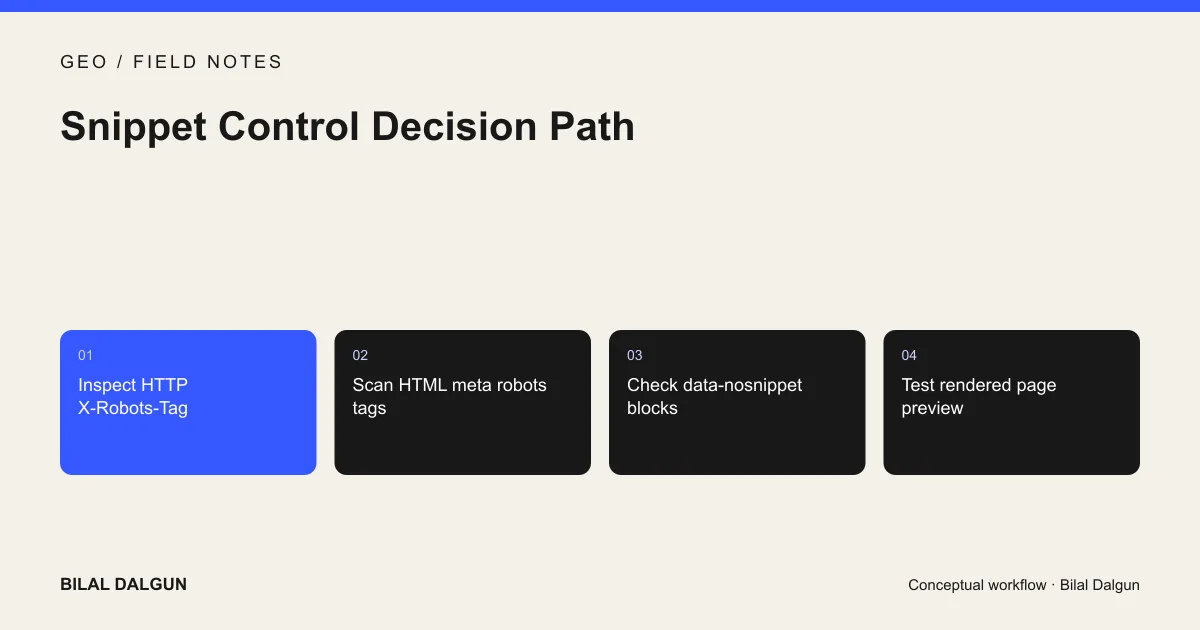
Step 2: Audit preview and snippet directives
Check for nosnippet, max-snippet:0, or overly broad data-nosnippet attributes wrapped around your core definitions or comparison tables. Restricting snippets prevents Search from displaying text previews and can limit how your page appears in generative summaries. Keep data-nosnippet strictly on boilerplate disclaimers or gated UI widgets rather than main article bodies.
Step 3: Check answer clarity and supporting evidence
Once technical eligibility is confirmed, review whether the page answers the buyer's core question within the opening two paragraphs. Pair concise definitions with dated primary sources and clean HTML tables so retrieval systems can extract facts without misreading layout noise. You can also review our guide on AI Overviews source selection for deeper citation patterns.
Technical Eligibility vs. Citation Selection
| Audit Dimension | Technical Eligibility (Gate A) | Citation Selection (Gate B) | Primary Fix Owner |
|---|---|---|---|
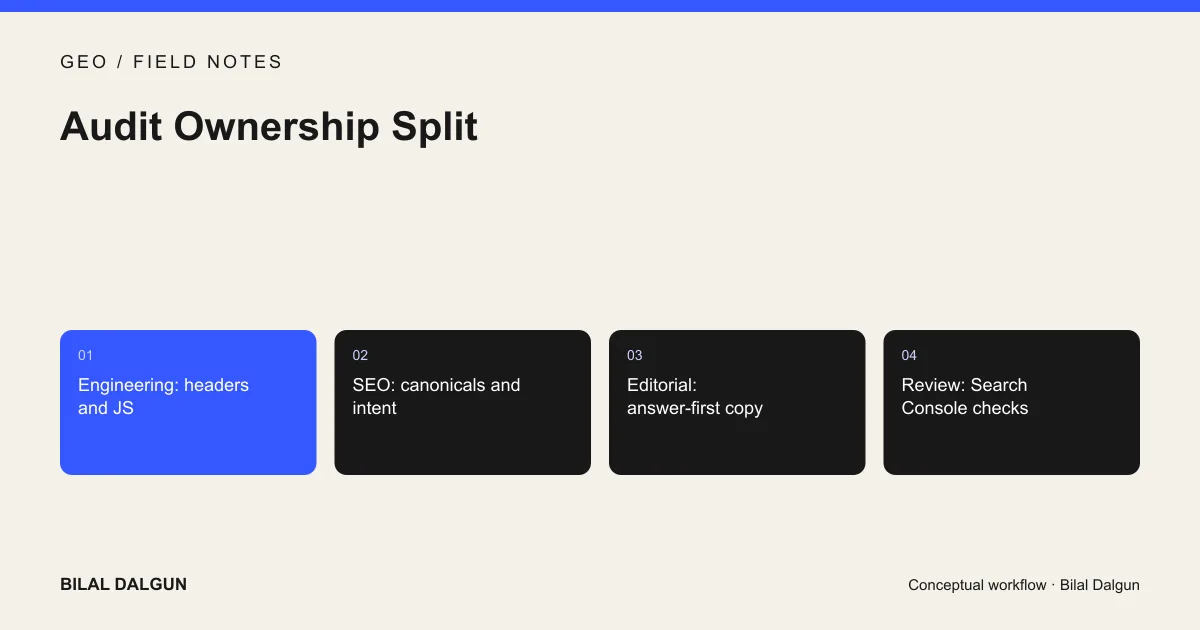
| Crawl and render access | Googlebot fetches HTML and JS | Clean semantic headings exist | Engineering / Technical SEO |
| Indexation status | Page is indexed and canonical | Topic aligns with search intent | Technical SEO / Content |
| Snippet availability | No blocking nosnippet rules |
Direct answer sits near top | Engineering / Editorial |
| Content quality | Meets Search Essentials baseline | Original steps, tables, sources | Editorial / Subject Expert |
| Expected outcome | URL enters candidate pool | URL earns link in overview | Combined SEO & GEO team |
Common mistakes that break eligibility
Most eligibility failures come from accidental restrictions shipped during site redesigns or CMS migrations. Teams frequently block JavaScript bundles in robots.txt, leaving client-rendered answers invisible during indexing.
Another common mistake is applying sitewide max-snippet caps out of fear of AI scraping, without realizing the same directive restricts standard search snippets and AI Overviews together. A third issue is duplicate URL parameters or canonical mismatches that dilute which version Google indexes. Whenever you restrict snippets or adjust crawl rules, test a single template directory first before rolling changes across the whole domain.
How I approach google ai overviews eligibility audits
When I run an eligibility audit, I never start by rewriting paragraphs or adding experimental files. I start with raw HTTP headers, rendered DOM inspection, and Search Console index coverage for the top 20 commercial and educational URLs.
In my practice, separating binary technical blockers from editorial improvements prevents teams from blaming copywriters for engineering rules. Once crawl, indexation, and snippet permissions are verified clean, I move to structural GEO upgrades like answer-first openings, comparison tables, and verifiable authorship. If you want structured templates and checklists for your team, explore my published books and resources or review our GEO and SEO advisory services.
Key takeaways
- Google AI Overviews require no special AI meta tags, proprietary feeds, or separate submission portals beyond core Search indexing.
- Technical eligibility (crawl, indexation, and snippet permission) is binary and must be verified before optimizing copy for citations.
- Directives such as
nosnippet,max-snippet:0, andnoindexdirectly limit how Search features preview and reference a page. - Google uses retrieval-augmented generation anchored in its core ranking systems, making foundational SEO and clear formatting mutually reinforcing.
- Separating Gate A technical checks from Gate B citation edits keeps engineering and editorial priorities clear.
FAQ
Do I need a special schema type or AI tag to appear in Google AI Overviews?
No, you do not need any special AI meta tag or dedicated schema type to be eligible for Google AI Overviews. Google Search Central confirms that fundamental SEO best practices, crawlable HTML, and standard indexation govern eligibility. Structured data helps clarify entities and page context, yet it does not unlock a separate AI inclusion switch.
Does blocking Google-Extended in robots.txt remove a site from AI Overviews?
No, blocking Google-Extended does not control inclusion in Google Search or AI Overviews. Googlebot handles crawling for core Search indexing and generative Search features like AI Overviews and AI Mode. To control how content appears in Search snippets and AI Overviews, you must use Search-specific directives such as noindex, nosnippet, or max-snippet.
Why does an indexed page still fail to appear as a link in AI Overviews?
An indexed page can pass technical eligibility and still miss citation selection if other pages satisfy the query more clearly. Google's grounding systems pull from core ranking and quality signals, favoring pages with direct answers, verifiable claims, and strong topical fit. Improving structure, clarity, and information gain helps eligible pages compete for citations.
How does data-nosnippet affect AI Overviews eligibility?
The data-nosnippet HTML attribute tells Google not to use text inside that specific element for search snippets or generative previews. If you wrap only cookie banners or legal footers, your page remains eligible. However, wrapping your main article body or key answer blocks in data-nosnippet removes the exact text needed for AI Overviews.
What to do next
- Export your top 25 revenue and educational URLs from Search Console and inspect live HTTP headers for
noindex,nosnippet, or restrictivemax-snippetrules. - Audit rendered HTML on key templates to verify that primary definitions, tables, and headings load without blocked scripts.
- Rewrite top-of-page answers and supporting tables on eligible URLs so each H2 opens with a standalone summary.
If you want an objective technical and content baseline before investing in new pages, book a discovery call with Bilal Dalgun and I will walk you through your current eligibility gaps.
Sources
- AI Features and Your Website | Google Search Central | Documentation | Google for Developers (2025-12-10)
- Google's Guide to Optimizing for Generative AI Features on Google Search | Google Search Central | Documentation | Googl (2026-07-10)
- Robots Meta Tags Specifications | Google Search Central | Documentation | Google for Developers (2026-03-24)